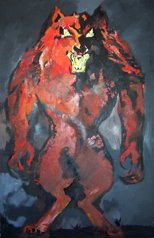
“Cattle, Horses, Sky, and Grass”
Sue Wallis
American
Cattle, horses, sky, and grass
These are the things that sway and pass
Before our eyes and through our dreams
Through shiny, sparkly, golden gleams
Within our psyche that find and know
The value of this special glow
That only gleams for those who bleed
Their soul and heart and utter need
Into the mighty, throbbing Earth
From which springs life and death and birth.
These cattle, horses, grass, and sky
Dance and dance and never die
They circle through the realms of air
And ground and empty spaces where
A human being can join the song
Can circle, too, and not go wrong
Amidst the natural, pulsing forces
Of sky and grass and cows and horses.
This chant of life cannot be heard
It must be felt, there is no word
To sing that could express the true
Significance of how we wind
Through all these hoops of Earth and mind
Through horses, cattle, sky, and grass
And all these things that sway and pass.
Tuesday, May 17, 2011

Friday, March 25, 2011
Quotations from “The Drunkard”
Frank O’Connor
1903-1966 Irish
Mr. Dooley was an intellectual, and, like all intellectuals the thing he loved best was conversation...
—Frank O’Connor, “The Drunkard”
It was with something like genuine pleasure that he saw his old friend lowered into the grave; with the sense of having performed a duty and the pleasant awareness that however much he would miss poor Mr. Dooley in the long summer evenings, it was he and not poor Mr. Dooley who would do the missing.
—Frank O’Connor, “The Drunkard”
Thursday, March 24, 2011
“The Fifty-First Dragon”
Heywood Broun
1888-1939 American
Of all the pupils at the knight school Gawaine le Cœur-Hardy was among the least promising. He was tall and sturdy, but his instructors soon discovered that he lacked spirit. He would hide in the woods when the jousting class was called, although his companions and members of the faculty sought to appeal to his better nature by shouting to him to come out and break his neck like a man. Even when they told him that the lances were padded, the horses no more than ponies and the field unusually soft for late autumn, Gawaine refused to grow enthusiastic. The Headmaster and the Assistant Professor of Pleasaunce were discussing the case one spring afternoon and the Assistant Professor could see no remedy but expulsion.
“No,” said the Headmaster, as he looked out at the purple hills which ringed the school, “I think I’ll train him to slay dragons.”
“He might be killed,” objected the Assistant Professor.
“So he might,” replied the Headmaster brightly, but he added, more soberly, “we must consider the greater good. We are responsible for the formation of this lad’s character.”
“Are the dragons particularly bad this year?” interrupted the Assistant Professor. This was characteristic. He always seemed restive when the head of the school began to talk ethics and the ideals of the institution.
“I’ve never known them worse,” replied the Headmaster. “Up in the hills to the south last week they killed a number of peasants, two cows and a prize pig. And if this dry spell holds there’s no telling when they may start a forest fire simply by breathing around indiscriminately.”
“Would any refund on the tuition fee be necessary in case of an accident to young Cœur Hardy?”
“No,” the principal answered, judicially, “that’s all covered in the contract. But as a matter of fact he won’t be killed. Before I send him up in the hills I’m going to give him a magic word.”
“That’s a good idea,” said the Professor. “Sometimes they work wonders.”
From that day on Gawaine specialized in dragons. His course included both theory and practice. In the morning there were long lectures on the history, anatomy, manners and customs of dragons. Gawaine did not distinguish himself in these studies. He had a marvelously versatile gift for forgetting things. In the afternoon he showed to better advantage, for then he would go down to the South Meadow and practise with a battle-ax. In this exercise he was truly impressive, for he had enormous strength as well as speed and grace. He even developed a deceptive display of ferocity. Old alumni say that it was a thrilling sight to see Gawaine charging across the field toward the dummy paper dragon which had been set up for his practice. As he ran he would brandish his ax and shout “A murrain on thee!” or some other vivid bit of campus slang. It never took him more than one stroke to behead the dummy dragon.
Gradually his task was made more difficult. Paper gave way to papier-mâché and finally to wood, but even the toughest of these dummy dragons had no terrors for Gawaine. One sweep of the ax always did the business. There were those who said that when the practice was protracted until dusk and the dragons threw long, fantastic shadows across the meadow Gawaine did not charge so impetuously nor shout so loudly. It is possible there was malice in this charge. At any rate, the Headmaster decided by the end of June that it was time for the test. Only the night before a dragon had come close to the school grounds and had eaten some of the lettuce from the garden. The faculty decided that Gawaine was ready. They gave him a diploma and a new battle-ax and the Headmaster summoned him to a private conference.
“Sit down,” said the Headmaster. “Have a cigarette.”
Gawaine hesitated.
“Oh, I know it’s against the rules,” said the Headmaster. “But after all, you have received your preliminary degree. You are no longer a boy. You are a man. To-morrow you will go out into the world, the great world of achievement.”
Gawaine took a cigarette. The Headmaster offered him a match, but he produced one of his own and began to puff away with a dexterity which quite amazed the principal.
“Here you have learned the theories of life,” continued the Headmaster, resuming the thread of his discourse, “but after all, life is not a matter of theories. Life is a matter of facts. It calls on the young and the old alike to face these facts, even though they are hard and sometimes unpleasant. Your problem, for example, is to slay dragons.”
“They say that those dragons down in the south wood are five hundred feet long,” ventured Gawaine, timorously.
“Stuff and nonsense!” said the Headmaster. “The curate saw one last week from the top of Arthur’s Hill. The dragon was sunning himself down in the valley. The curate didn’t have an opportunity to look at him very long because he felt it was his duty to hurry back to make a report to me. He said the monster, or shall I say, the big lizard?—wasn’t an inch over two hundred feet. But the size has nothing at all to do with it. You’ll find the big ones even easier than the little ones. They’re far slower on their feet and less aggressive, I’m told. Besides, before you go I’m going to equip you in such fashion that you need have no fear of all the dragons in the world.”
“I’d like an enchanted cap,” said Gawaine.
“What’s that?” answered the Headmaster, testily.
“A cap to make me disappear,” explained Gawaine.
The Headmaster laughed indulgently. “You mustn’t believe all those old wives’ stories,” he said. “There isn’t any such thing. A cap to make you disappear, indeed! What would you do with it? You haven’t even appeared yet. Why, my boy, you could walk from here to London, and nobody would so much as look at you. You’re nobody. You couldn’t be more invisible than that.”
Gawaine seemed dangerously close to a relapse into his old habit of whimpering. The Headmaster reassured him: “Don’t worry; I’ll give you something much better than an enchanted cap. I’m going to give you a magic word. All you have to do is to repeat this magic charm once and no dragon can possibly harm a hair of your head. You can cut off his head at your leisure.”
He took a heavy book from the shelf behind his desk and began to run through it. “Sometimes,” he said, “the charm is a whole phrase or even a sentence. I might, for instance, give you ‘To make the’—No, that might not do. I think a single word would be best for dragons.”
“A short word,” suggested Gawaine.
“It can’t be too short or it wouldn’t be potent. There isn’t so much hurry as all that. Here’s a splendid magic word: ‘Rumplesnitz.’ Do you think you can learn that?”
Gawaine tried and in an hour or so he seemed to have the word well in hand. Again and again he interrupted the lesson to inquire, “And if I say ‘Rumplesnitz’ the dragon can’t possibly hurt me?” And always the Headmaster replied, “If you only say ‘Rumplesnitz,’ you are perfectly safe.”
Toward morning Gawaine seemed resigned to his career. At daybreak the Headmaster saw him to the edge of the forest and pointed him to the direction in which he should proceed. About a mile away to the southwest a cloud of steam hovered over an open meadow in the woods and the Headmaster assured Gawaine that under the steam he would find a dragon. Gawaine went forward slowly. He wondered whether it would be best to approach the dragon on the run as he did in his practice in the South Meadow or to walk slowly toward him, shouting “Rumplesnitz” all the way.
The problem was decided for him. No sooner had he come to the fringe of the meadow than the dragon spied him and began to charge. It was a large dragon and yet it seemed decidedly aggressive in spite of the Headmaster’s statement to the contrary. As the dragon charged it released huge clouds of hissing steam through its nostrils. It was almost as if a gigantic teapot had gone mad. The dragon came forward so fast and Gawaine was so frightened that he had time to say “Rumplesnitz” only once. As he said it, he swung his battle-ax and off popped the head of the dragon. Gawaine had to admit that it was even easier to kill a real dragon than a wooden one if only you said “Rumplesnitz.”
Gawaine brought the ears home and a small section of the tail. His school mates and the faculty made much of him, but the Headmaster wisely kept him from being spoiled by insisting that he go on with his work. Every clear day Gawaine rose at dawn and went out to kill dragons. The Headmaster kept him at home when it rained, because he said the woods were damp and unhealthy at such times and that he didn’t want the boy to run needless risks. Few good days passed in which Gawaine failed to get a dragon. On one particularly fortunate day he killed three, a husband and wife and a visiting relative. Gradually he developed a technique. Pupils who sometimes watched him from the hill-tops a long way off said that he often allowed the dragon to come within a few feet before he said “Rumplesnitz.” He came to say it with a mocking sneer. Occasionally he did stunts. Once when an excursion party from London was watching him he went into action with his right hand tied behind his back. The dragon’s head came off just as easily.
As Gawaine’s record of killings mounted higher the Headmaster found it impossible to keep him completely in hand. He fell into the habit of stealing out at night and engaging in long drinking bouts at the village tavern. It was after such a debauch that he rose a little before dawn one fine August morning and started out after his fiftieth dragon. His head was heavy and his mind sluggish. He was heavy in other respects as well, for he had adopted the somewhat vulgar practice of wearing his medals, ribbons and all, when he went out dragon hunting. The decorations began on his chest and ran all the way down to his abdomen. They must have weighed at least eight pounds.
Gawaine found a dragon in the same meadow where he had killed the first one. It was a fair-sized dragon, but evidently an old one. Its face was wrinkled and Gawaine thought he had never seen so hideous a countenance. Much to the lad’s disgust, the monster refused to charge and Gawaine was obliged to walk toward him. He whistled as he went. The dragon regarded him hopelessly, but craftily. Of course it had heard of Gawaine. Even when the lad raised his battle-ax the dragon made no move. It knew that there was no salvation in the quickest thrust of the head, for it had been informed that this hunter was protected by an enchantment. It merely waited, hoping something would turn up. Gawaine raised the battle-ax and suddenly lowered it again. He had grown very pale and he trembled violently. The dragon suspected a trick. “What’s the matter?” it asked, with false solicitude.
“I’ve forgotten the magic word,” stammered Gawaine.
“What a pity,” said the dragon. “So that was the secret. It doesn’t seem quite sporting to me, all this magic stuff, you know. Not cricket, as we used to say when I was a little dragon; but after all, that’s a matter of opinion.”
Gawaine was so helpless with terror that the dragon’s confidence rose immeasurably and it could not resist the temptation to show off a bit.
“Could I possibly be of any assistance?” it asked. “What’s the first letter of the magic word?”
“It begins with an ‘r,”’ said Gawaine weakly.
“Let’s see,” mused the dragon, “that doesn’t tell us much, does it? What sort of a word is this? Is it an epithet, do you think?”
Gawaine could do no more than nod.
“Why, of course,” exclaimed the dragon, “reactionary Republican.”
Gawaine shook his head.
“Well, then,” said the dragon, “we’d better get down to business. Will you surrender?”
With the suggestion of a compromise Gawaine mustered up enough courage to speak.
“What will you do if I surrender?” he asked.
“Why, I’ll eat you,” said the dragon.
“And if I don’t surrender?”
“I’ll eat you just the same.”
“Then it doesn’t mean any difference, does it?” moaned Gawaine.
“It does to me,” said the dragon with a smile. “I’d rather you didn’t surrender. You’d taste much better if you didn’t.”
The dragon waited for a long time for Gawaine to ask “Why?” but the boy was too frightened to speak. At last the dragon had to give the explanation without his cue line. “You see,” he said, “if you don’t surrender you’ll taste better because you’ll die game.”
This was an old and ancient trick of the dragon’s. By means of some such quip he was accustomed to paralyze his victims with laughter and then to destroy them. Gawaine was sufficiently paralyzed as it was, but laughter had no part in his helplessness. With the last word of the joke the dragon drew back his head and struck. In that second there flashed into the mind of Gawaine the magic word “Rumplesnitz,” but there was no time to say it. There was time only to strike and, without a word, Gawaine met the onrush of the dragon with a full swing. He put all his back and shoulders into it. The impact was terrific and the head of the dragon flew away almost a hundred yards and landed in a thicket.
Gawaine did not remain frightened very long after the death of the dragon. His mood was one of wonder. He was enormously puzzled. He cut off the ears of the monster almost in a trance. Again and again he thought to himself, “I didn’t say ‘Rumplesnitz’!” He was sure of that and yet there was no question that he had killed the dragon. In fact, he had never killed one so utterly. Never before had he driven a head for anything like the same distance. Twenty-five yards was perhaps his best previous record. All the way back to the knight school he kept rumbling about in his mind seeking an explanation for what had occurred. He went to the Headmaster immediately and after closing the door told him what had happened. “I didn’t say ‘Rumplesnitz,’” he explained with great earnestness.
The Headmaster laughed. “I’m glad you’ve found out,” he said. “It makes you ever so much more of a hero. Don’t you see that? Now you know that it was you who killed all these dragons and not that foolish little word ‘Rumplesnitz.’”
Gawaine frowned. “Then it wasn’t a magic word after all?” he asked.
“Of course not,” said the Headmaster, “you ought to be too old for such foolishness. There isn’t any such thing as a magic word.”
“But you told me it was magic,” protested Gawaine. “You said it was magic and now you say it isn’t.”
“It wasn’t magic in a literal sense,” answered the Headmaster, “but it was much more wonderful than that. The word gave you confidence. It took away your fears. If I hadn’t told you that you might have been killed the very first time. It was your battle-ax did the trick.”
Gawaine surprised the Headmaster by his attitude, He was obviously distressed by the explanation. He interrupted a long philosophic and ethical discourse by the Headmaster with, “If I hadn’t of hit ’em all mighty hard and fast any one of ’em might have crushed me like a, like a—” He fumbled for a word.
“Egg shell,” suggested the Headmaster.
“Like a egg shell,” assented Gawaine, and he said it many times. All through the evening meal people who sat near him heard him muttering, “Like a egg shell, like a egg shell.”
The next day was clear, but Gawaine did not get up at dawn. Indeed, it was almost noon when the Headmaster found him cowering in bed, with the clothes pulled over his head. The principal called the Assistant Professor of Pleasaunce, and together they dragged the boy toward the forest.
“He’ll be all right as soon as he gets a couple more dragons under his belt,” explained the Headmaster.
“The Assistant Professor of Pleasaunce agreed. “It would be a shame to stop such a fine run,” he said. “Why, counting that one yesterday, he’s killed fifty dragons.”
They pushed the boy into a thicket above which hung a meager cloud of steam. It was obviously quite a small dragon. But Gawaine did not come back that night or the next. In fact, he never came back. Some weeks afterward brave spirits from the school explored the thicket, but they could find nothing to remind them of Gawaine except the metal parts of his medals. Even the ribbons had been devoured.
The Headmaster and the Assistant Professor of Pleasaunce agreed that it would be just as well not to tell the school how Gawaine had achieved his record and still less how he came to die. They held that it might have a bad effect on school spirit. Accordingly, Gawaine has lived in the memory of the school as its greatest hero. No visitor succeeds in leaving the building to-day without seeing a great shield which hangs on the wall of the dining hall. Fifty pairs of dragons’ ears are mounted upon the shield and underneath in gilt letters is “Gawaine le Cœur-Hardy,” followed by the simple inscription, “He killed fifty dragons.” The record has never been equaled.
Friday, December 3, 2010
“God Sees the Truth, But Waits”
Leo Tolstoy
1828-1910 Russian
In the town of Vladimir lived a young merchant named Ivan Dmitrich Aksionov. He had two shops and a house of his own.
Aksionov was a handsome, fair-haired, curly-headed fellow, full of fun, and very fond of singing. When quite a young man he had been given to drink, and was riotous when he had had too much; but after he married he gave up drinking, except now and then.
One summer Aksionov was going to the Nizhny Fair, and as he bade good-bye to his family, his wife said to him, "Ivan Dmitrich, do not start to-day; I have had a bad dream about you."
Aksionov laughed, and said, "You are afraid that when I get to the fair I shall go on a spree."
His wife replied: "I do not know what I am afraid of; all I know is that I had a bad dream. I dreamt you returned from the town, and when you took off your cap I saw that your hair was quite grey."
Aksionov laughed. "That's a lucky sign," said he. "See if I don't sell out all my goods, and bring you some presents from the fair."
So he said good-bye to his family, and drove away.
When he had travelled half-way, he met a merchant whom he knew, and they put up at the same inn for the night. They had some tea together, and then went to bed in adjoining rooms.
It was not Aksionov's habit to sleep late, and, wishing to travel while it was still cool, he aroused his driver before dawn, and told him to put in the horses.
Then he made his way across to the landlord of the inn (who lived in a cottage at the back), paid his bill, and continued his journey.
When he had gone about twenty-five miles, he stopped for the horses to be fed. Aksionov rested awhile in the passage of the inn, then he stepped out into the porch, and, ordering a samovar to be heated, got out his guitar and began to play.
Suddenly a troika drove up with tinkling bells and an official alighted, followed by two soldiers. He came to Aksionov and began to question him, asking him who he was and whence he came. Aksionov answered him fully, and said, "Won't you have some tea with me?" But the official went on cross-questioning him and asking him. "Where did you spend last night? Were you alone, or with a fellow-merchant? Did you see the other merchant this morning? Why did you leave the inn before dawn?"
Aksionov wondered why he was asked all these questions, but he described all that had happened, and then added, "Why do you cross-question me as if I were a thief or a robber? I am travelling on business of my own, and there is no need to question me."
Then the official, calling the soldiers, said, "I am the police-officer of this district, and I question you because the merchant with whom you spent last night has been found with his throat cut. We must search your things."
They entered the house. The soldiers and the police-officer unstrapped Aksionov's luggage and searched it. Suddenly the officer drew a knife out of a bag, crying, "Whose knife is this?"
Aksionov looked, and seeing a blood-stained knife taken from his bag, he was frightened.
"How is it there is blood on this knife?"
Aksionov tried to answer, but could hardly utter a word, and only stammered: "I--don't know--not mine." Then the police-officer said: "This morning the merchant was found in bed with his throat cut. You are the only person who could have done it. The house was locked from inside, and no one else was there. Here is this blood-stained knife in your bag and your face and manner betray you! Tell me how you killed him, and how much money you stole?"
Aksionov swore he had not done it; that he had not seen the merchant after they had had tea together; that he had no money except eight thousand rubles of his own, and that the knife was not his. But his voice was broken, his face pale, and he trembled with fear as though he went guilty.
The police-officer ordered the soldiers to bind Aksionov and to put him in the cart. As they tied his feet together and flung him into the cart, Aksionov crossed himself and wept. His money and goods were taken from him, and he was sent to the nearest town and imprisoned there. Enquiries as to his character were made in Vladimir. The merchants and other inhabitants of that town said that in former days he used to drink and waste his time, but that he was a good man. Then the trial came on: he was charged with murdering a merchant from Ryazan, and robbing him of twenty thousand rubles.
His wife was in despair, and did not know what to believe. Her children were all quite small; one was a baby at her breast. Taking them all with her, she went to the town where her husband was in jail. At first she was not allowed to see him; but after much begging, she obtained permission from the officials, and was taken to him. When she saw her husband in prison-dress and in chains, shut up with thieves and criminals, she fell down, and did not come to her senses for a long time. Then she drew her children to her, and sat down near him. She told him of things at home, and asked about what had happened to him. He told her all, and she asked, "What can we do now?"
"We must petition the Czar not to let an innocent man perish."
His wife told him that she had sent a petition to the Czar, but it had not been accepted.
Aksionov did not reply, but only looked downcast.
Then his wife said, "It was not for nothing I dreamt your hair had turned grey. You remember? You should not have started that day." And passing her fingers through his hair, she said: "Vanya dearest, tell your wife the truth; was it not you who did it?"
"So you, too, suspect me!" said Aksionov, and, hiding his face in his hands, he began to weep. Then a soldier came to say that the wife and children must go away; and Aksionov said good-bye to his family for the last time.
When they were gone, Aksionov recalled what had been said, and when he remembered that his wife also had suspected him, he said to himself, "It seems that only God can know the truth; it is to Him alone we must appeal, and from Him alone expect mercy."
And Aksionov wrote no more petitions; gave up all hope, and only prayed to God.
Aksionov was condemned to be flogged and sent to the mines. So he was flogged with a knot, and when the wounds made by the knot were healed, he was driven to Siberia with other convicts.
For twenty-six years Aksionov lived as a convict in Siberia. His hair turned white as snow, and his beard grew long, thin, and grey. All his mirth went; he stooped; he walked slowly, spoke little, and never laughed, but he often prayed.
In prison Aksionov learnt to make boots, and earned a little money, with which he bought The Lives of the Saints. He read this book when there was light enough in the prison; and on Sundays in the prison-church he read the lessons and sang in the choir; for his voice was still good.
The prison authorities liked Aksionov for his meekness, and his fellow-prisoners respected him: they called him "Grandfather," and "The Saint." When they wanted to petition the prison authorities about anything, they always made Aksionov their spokesman, and when there were quarrels among the prisoners they came to him to put things right, and to judge the matter.
No news reached Aksionov from his home, and he did not even know if his wife and children were still alive.
One day a fresh gang of convicts came to the prison. In the evening the old prisoners collected round the new ones and asked them what towns or villages they came from, and what they were sentenced for. Among the rest Aksionov sat down near the newcomers, and listened with downcast air to what was said.
One of the new convicts, a tall, strong man of sixty, with a closely-cropped grey beard, was telling the others what be had been arrested for.
"Well, friends," he said, "I only took a horse that was tied to a sledge, and I was arrested and accused of stealing. I said I had only taken it to get home quicker, and had then let it go; besides, the driver was a personal friend of mine. So I said, 'It's all right.' 'No,' said they, 'you stole it.' But how or where I stole it they could not say. I once really did something wrong, and ought by rights to have come here long ago, but that time I was not found out. Now I have been sent here for nothing at all... Eh, but it's lies I'm telling you; I've been to Siberia before, but I did not stay long."
"Where are you from?" asked some one.
"From Vladimir. My family are of that town. My name is Makar, and they also call me Semyonich."
Aksionov raised his head and said: "Tell me, Semyonich, do you know anything of the merchants Aksionov of Vladimir? Are they still alive?"
"Know them? Of course I do. The Aksionovs are rich, though their father is in Siberia: a sinner like ourselves, it seems! As for you, Gran'dad, how did you come here?"
Aksionov did not like to speak of his misfortune. He only sighed, and said, "For my sins I have been in prison these twenty-six years."
"What sins?" asked Makar Semyonich.
But Aksionov only said, "Well, well--I must have deserved it!" He would have said no more, but his companions told the newcomers how Aksionov came to be in Siberia; how some one had killed a merchant, and had put the knife among Aksionov's things, and Aksionov had been unjustly condemned.
When Makar Semyonich heard this, he looked at Aksionov, slapped his own knee, and exclaimed, "Well, this is wonderful! Really wonderful! But how old you've grown, Gran'dad!"
The others asked him why he was so surprised, and where he had seen Aksionov before; but Makar Semyonich did not reply. He only said: "It's wonderful that we should meet here, lads!"
These words made Aksionov wonder whether this man knew who had killed the merchant; so he said, "Perhaps, Semyonich, you have heard of that affair, or maybe you've seen me before?"
"How could I help hearing? The world's full of rumours. But it's a long time ago, and I've forgotten what I heard."
"Perhaps you heard who killed the merchant?" asked Aksionov.
Makar Semyonich laughed, and replied: "It must have been him in whose bag the knife was found! If some one else hid the knife there, 'He's not a thief till he's caught,' as the saying is. How could any one put a knife into your bag while it was under your head? It would surely have woke you up."
When Aksionov heard these words, he felt sure this was the man who had killed the merchant. He rose and went away. All that night Aksionov lay awake. He felt terribly unhappy, and all sorts of images rose in his mind. There was the image of his wife as she was when he parted from her to go to the fair. He saw her as if she were present; her face and her eyes rose before him; he heard her speak and laugh. Then he saw his children, quite little, as they: were at that time: one with a little cloak on, another at his mother's breast. And then he remembered himself as he used to be-young and merry. He remembered how he sat playing the guitar in the porch of the inn where he was arrested, and how free from care he had been. He saw, in his mind, the place where he was flogged, the executioner, and the people standing around; the chains, the convicts, all the twenty-six years of his prison life, and his premature old age. The thought of it all made him so wretched that he was ready to kill himself.
"And it's all that villain's doing!" thought Aksionov. And his anger was so great against Makar Semyonich that he longed for vengeance, even if he himself should perish for it. He kept repeating prayers all night, but could get no peace. During the day he did not go near Makar Semyonich, nor even look at him.
A fortnight passed in this way. Aksionov could not sleep at night, and was so miserable that he did not know what to do.
One night as he was walking about the prison he noticed some earth that came rolling out from under one of the shelves on which the prisoners slept. He stopped to see what it was. Suddenly Makar Semyonich crept out from under the shelf, and looked up at Aksionov with frightened face. Aksionov tried to pass without looking at him, but Makar seized his hand and told him that he had dug a hole under the wall, getting rid of the earth by putting it into his high-boots, and emptying it out every day on the road when the prisoners were driven to their work.
"Just you keep quiet, old man, and you shall get out too. If you blab, they'll flog the life out of me, but I will kill you first."
Aksionov trembled with anger as he looked at his enemy. He drew his hand away, saying, "I have no wish to escape, and you have no need to kill me; you killed me long ago! As to telling of you--I may do so or not, as God shall direct."
Next day, when the convicts were led out to work, the convoy soldiers noticed that one or other of the prisoners emptied some earth out of his boots. The prison was searched and the tunnel found. The Governor came and questioned all the prisoners to find out who had dug the hole. They all denied any knowledge of it. Those who knew would not betray Makar Semyonich, knowing he would be flogged almost to death. At last the Governor turned to Aksionov whom he knew to be a just man, and said:
"You are a truthful old man; tell me, before God, who dug the hole?"
Makar Semyonich stood as if he were quite unconcerned, looking at the Governor and not so much as glancing at Aksionov. Aksionov's lips and hands trembled, and for a long time he could not utter a word. He thought, "Why should I screen him who ruined my life? Let him pay for what I have suffered. But if I tell, they will probably flog the life out of him, and maybe I suspect him wrongly. And, after all, what good would it be to me?"
"Well, old man," repeated the Governor, "tell me the truth: who has been digging under the wall?"
Aksionov glanced at Makar Semyonich, and said, "I cannot say, your honour. It is not God's will that I should tell! Do what you like with me; I am your hands."
However much the Governor! tried, Aksionov would say no more, and so the matter had to be left.
That night, when Aksionov was lying on his bed and just beginning to doze, some one came quietly and sat down on his bed. He peered through the darkness and recognised Makar.
"What more do you want of me?" asked Aksionov. "Why have you come here?"
Makar Semyonich was silent. So Aksionov sat up and said, "What do you want? Go away, or I will call the guard!"
Makar Semyonich bent close over Aksionov, and whispered, "Ivan Dmitrich, forgive me!"
"What for?" asked Aksionov.
"It was I who killed the merchant and hid the knife among your things. I meant to kill you too, but I heard a noise outside, so I hid the knife in your bag and escaped out of the window."
Aksionov was silent, and did not know what to say. Makar Semyonich slid off the bed-shelf and knelt upon the ground. "Ivan Dmitrich," said he, "forgive me! For the love of God, forgive me! I will confess that it was I who killed the merchant, and you will be released and can go to your home."
"It is easy for you to talk," said Aksionov, "but I have suffered for you these twenty-six years. Where could I go to now?... My wife is dead, and my children have forgotten me. I have nowhere to go..."
Makar Semyonich did not rise, but beat his head on the floor. "Ivan Dmitrich, forgive me!" he cried. "When they flogged me with the knot it was not so hard to bear as it is to see you now ... yet you had pity on me, and did not tell. For Christ's sake forgive me, wretch that I am!" And he began to sob.
When Aksionov heard him sobbing he, too, began to weep. "God will forgive you!" said he. "Maybe I am a hundred times worse than you." And at these words his heart grew light, and the longing for home left him. He no longer had any desire to leave the prison, but only hoped for his last hour to come.
In spite of what Aksionov had said, Makar Semyonich confessed his guilt. But when the order for his release came, Aksionov was already dead.
Tuesday, November 16, 2010
“Total Security”
David Roberts
British
By arming themselves
with sufficient bombs
to destroy the world,
and being
the world's number one country
at dropping bombs
America is making enemies
of the entire human race.
If the human race
ever dares to strike back
America will have no alternative
but to destroy the entire world
in self-defence.
Quotations from *Moby-Dick; or, The Whale*, 1 of 22
Herman Melville
1819-1891 American
Call me Ishmael. Some years ago -- never mind how long precisely -- having little or no money in my purse, and nothing particular to interest me on shore, I thought I would sail about a little and see the watery part of the world. It is a way I have of driving off the spleen, and regulating the circulation. Whenever I find myself growing grim about the mouth; whenever it is a damp, drizzly November in my soul; whenever I find myself involuntarily pausing before coffin warehouses, and bringing up the rear of every funeral I meet; and especially whenever my hypos get such an upper hand of me, that it requires a strong moral principle to prevent me from deliberately stepping into the street, and methodically knocking people's hats off -- then, I account it high time to get to sea as soon as I can. This is my substitute for pistol and ball.
—Herman Melville, Moby-Dick; or, The Whale
Why upon your first voyage as a passenger, did you yourself feel such a mystical vibration, when first told that you and your ship were now out of sight of land?
—Herman Melville, Moby-Dick; or, The Whale
No, I never go as a passenger; nor, though I am something of a salt, do I ever go to sea as a Commodore, or a Captain, or a Cook. I abandon the glory and distinction of such offices to those who like them. For my part, I abominate all honorable respectable toils, trials, and tribulations of every kind whatsoever. It is quite as much as I can do to take care of myself, without taking care of ships, barques, brigs, schooners, and what not.
—Herman Melville, Moby-Dick; or, The Whale
Who ain’t a slave?
—Herman Melville, Moby-Dick; or, The Whale
On no account can a monied man enter heaven. Ah! how cheerfully we consign ourselves to perdition!
—Herman Melville, Moby-Dick; or, The Whale
Chief among these motives was the overwhelming idea of the great whale himself. Such a portentous and mysterious monster roused all my curiosity.
—Herman Melville, Moby-Dick; or, The Whale
With other men, perhaps, such things would not have been inducements; but as for me, I am tormented with an everlasting itch for things remote. I love to sail forbidden seas, and land on barbarous coasts.
—Herman Melville, Moby-Dick; or, The Whale
I stood in the middle of a dreary street shouldering my bag, and comparing the gloom towards the north with the darkness towards the south.
—Herman Melville, Moby-Dick; or, The Whale
But it's too late to make any improvements now. The universe is finished; the copestone is on, and the chips were carted off a million years ago.
—Herman Melville, Moby-Dick; or, The Whale
Would he not far rather... yea, ye gods! go down to the fiery pit itself, in order to keep out this frost?
—Herman Melville, Moby-Dick; or, The Whale
Such unaccountable masses of shades and shadows, that at first you almost thought some ambitious young artist, in the time of the New England hags, had endeavored to delineate chaos bewitched. But by dint of much and earnest contemplation, and oft repeated ponderings, and especially by throwing open the little window towards the back of the entry, you at last come to the conclusion that such an idea, however wild, might not be altogether unwarranted.
—Herman Melville, Moby-Dick; or, The Whale
“Supper? -- you want supper? Supper’ll be ready directly.”
—Herman Melville, Moby-Dick; or, The Whale
However, a good laugh is a mighty good thing, and rather too scarce a good thing.
—Herman Melville, Moby-Dick; or, The Whale
Monday, November 15, 2010
“At the Bomb Testing Site”
William Stafford
1914-1993 American
At noon in the desert a panting lizard
waited for history, its elbows tense,
watching the curve of a particular road
as if something might happen.
It was looking at something farther off
than people could see, an important scene
acted in stone for little selves
at the flute end of consequences.
There was just a continent without much on it
under a sky that never cared less.
Ready for a change, the elbows waited.
The hands gripped hard on the desert.
Quotations from *Moby-Dick; or, The Whale*, 2 of 22
Herman Melville
1819-1891 American
They say that men who have seen the world, thereby become quite at ease in manner, quite self-possessed in company.
—Herman Melville, Moby-Dick; or, The Whale
How it is that to his name who yesterday departed for the other world, we prefix so significant and infidel a word, and yet do not thus entitle him, if he but embarks for the remotest Indies of this living earth; why the Life Insurance Companies pay death-forfeitures upon immortals; in what eternal, unstirring paralysis, and deadly, hopeless trance, yet lies antique Adam who died sixty round centuries ago; how it is that we still refuse to be comforted for those who we nevertheless maintain are dwelling in unspeakable bliss; why all the living so strive to hush all the dead; wherefore but the rumor of a knocking in a tomb will terrify a whole city. All these things are not without their meanings.
—Herman Melville, Moby-Dick; or, The Whale
Yes, there is death in this business of whaling -- a speechlessly quick chaotic bundling of a man into Eternity. But what then? Methinks we have hugely mistaken this matter of Life and Death.
—Herman Melville, Moby-Dick; or, The Whale
“He oftener commands us than endeavors to persuade. And if we obey God, we must disobey ourselves.”
—Herman Melville, Moby-Dick; or, The Whale
“In this world, shipmates, sin that pays its way can travel freely, and without a passport; whereas Virtue, if a pauper, is stopped at all frontiers.”
—Herman Melville, Moby-Dick; or, The Whale
“At last amid the whirl of woe he feels, a deep stupor steals over him, as over the man who bleeds to death, for conscience is the wound, and there's naught to staunch it; so, after sore wrestlings in his berth, Jonah's prodigy of ponderous misery drags him drowning down to sleep.”
—Herman Melville, Moby-Dick; or, The Whale
“Woe to him who seeks to please rather than to appal! Woe to him whose good name is more to him than goodness!”
—Herman Melville, Moby-Dick; or, The Whale
“Delight is to him -- a far, far upward, and inward delight -- who against the proud gods and commodores of this earth, ever stands forth his own inexorable self. Delight is to him whose strong arms yet support him, when the ship of this base treacherous world has gone down beneath him.”
—Herman Melville, Moby-Dick; or, The Whale
“Yet this is nothing; I leave eternity to Thee; for what is man that he should live out the lifetime of his God?”
He said no more, but slowly waving a benediction, covered his face with his hands, and so remained kneeling, till all the people had departed, and he was left alone in the place.
—Herman Melville, Moby-Dick; or, The Whale
For the height of this sort of deliciousness is to have nothing but the blanket between you and your snugness and the cold of the outer air.
—Herman Melville, Moby-Dick; or, The Whale
Because no man can ever feel his own identity aright except his eyes be closed; as if darkness were indeed the proper element of our essences, though light be more congenial to our clayey part.
—Herman Melville, Moby-Dick; or, The Whale
Queequeg was a native of Kokovoko, an island far away to the West and South. It is not down in any map; true places never are.
—Herman Melville, Moby-Dick; or, The Whale
Thought he, it's a wicked world in all meridians; I'll die a pagan.
—Herman Melville, Moby-Dick; or, The Whale
He had a particular affection for his own harpoon, because it was of assured stuff, well tried in many a mortal combat, and deeply intimate with the hearts of whales.
—Herman Melville, Moby-Dick; or, The Whale
One most perilous and long voyage ended, only begins a second; and a second ended, only begins a third, and so on, for ever and for aye. Such is the endlessness, yea, the intolerableness of all earthly effort.
—Herman Melville, Moby-Dick; or, The Whale
But these extravaganzas only show that Nantucket is no Illinois.
—Herman Melville, Moby-Dick; or, The Whale
Let America add Mexico to Texas, and pile Cuba upon Canada; let the English overswarm all India, and hang out their blazing banner from the sun; two thirds of this terraqueous globe are the Nantucketer's. For the sea is his; he owns it, as Emperors own empires; other seamen having but a right of way through it. Merchant ships are but extension bridges; armed ones but floating forts; even pirates and privateers, though following the sea as highwaymen the road, they but plunder other ships, other fragments of the land like themselves, without seeking to draw their living from the bottomless deep itself. The Nantucketer, he alone resides and riots on the sea.... There is his home; there lies his business, which a Noah’s flood would not interrupt, though it overwhelmed all the millions in China. He lives on the sea.
—Herman Melville, Moby-Dick; or, The Whale
Scorning a turnstile wheel at her reverend helm, she sported there a tiller; and that tiller was in one mass, curiously carved from the long narrow lower jaw of her hereditary foe. The helmsman who steered by that tiller in a tempest, felt like the Tartar, when he holds back his fiery steed by clutching its jaw. A noble craft, but somehow a most melancholy! All noble things are touched with that.
—Herman Melville, Moby-Dick; or, The Whale
“But as I was going to say, if thou wantest to know what whaling is, as thou tellest ye do, I can put ye in a way of finding it out before ye bind yourself to it, past backing out. Clap eye on Captain Ahab, young man, and thou wilt find that he has only one leg.”
“What do you mean, sir? Was the other one lost by a whale?”
“Lost by a whale! Young man, come nearer to me: it was devoured, chewed up, crunched by the monstrousest parmacetty that ever chipped a boat! -- ah, ah!”
—Herman Melville, Moby-Dick; or, The Whale
People in Nantucket invest their money in whaling vessels, the same way that you do yours in approved state stocks bringing in good interest.
—Herman Melville, Moby-Dick; or, The Whale
For some of these same Quakers are the most sanguinary of all sailors and whale-hunters. They are fighting Quakers; they are Quakers with a vengeance.
—Herman Melville, Moby-Dick; or, The Whale
Be sure of this, O young ambition, all mortal greatness is but disease.
—Herman Melville, Moby-Dick; or, The Whale
Though refusing, from conscientious scruples, to bear arms against land invaders, yet himself had illimitably invaded the Atlantic and Pacific; and though a sworn foe to human bloodshed, yet had he in his straight-bodied coat, spilled tuns upon tuns of leviathan gore. How now in the contemplative evening of his days, the pious Bildad reconciled these things in the reminiscence, I do not know; but it did not seem to concern him much, and very probably he had long since come to the sage and sensible conclusion that a man's religion is one thing, and this practical world quite another. This world pays dividends.
—Herman Melville, Moby-Dick; or, The Whale
“He says he's our man, Bildad,” said Peleg, “he wants to ship.”
“Dost thee?” said Bildad, in a hollow tone, and turning round to me.
“I dost,” said I unconsciously, he was so intense a Quaker.
—Herman Melville, Moby-Dick; or, The Whale
“He’s a grand, ungodly, god-like man, Captain Ahab; doesn't speak much; but, when he does speak, then you may well listen. Mark ye, be forewarned; Ahab's above the common; Ahab's been in colleges, as well as 'mong the cannibals; been used to deeper wonders than the waves; fixed his fiery lance in mightier stranger foes than whales.”
—Herman Melville, Moby-Dick; or, The Whale
I cherish the greatest respect towards everybody's religious obligations, never mind how comical, and could not find it in my heart to undervalue even a congregation of ants worshipping a toad-stool; or those other creatures in certain parts of our earth, who with a degree of footmanism quite unprecedented in other planets, bow down before the torso of a deceased landed proprietor merely on account of the inordinate possessions yet owned and rented in his name.
—Herman Melville, Moby-Dick; or, The Whale
Hell is an idea first born on an undigested apple-dumpling; and since then perpetuated through the hereditary dyspepsias nurtured by Ramadans.
—Herman Melville, Moby-Dick; or, The Whale
“Pious harpooneers never make good voyagers -- it takes the shark out of 'em.”
—Herman Melville, Moby-Dick; or, The Whale
Saturday, October 16, 2010
“Trenches: St Eloi”
T.E. Hulme
1883-1917 English
recorded by Ezra Pound
Over the flat slopes of St Eloi
A wide wall of sand bags.
Night,
In the silence desultory men
Pottering over small fires, cleaning their mess-tins:
To and fro, from the lines,
Men walk as on Piccadilly,
Making paths in the dark,
Through scattered dead horses,
Over a dead Belgian’s belly.
The Germans have rockets. The English have no rockets.
Behind the line, cannon, hidden, lying back miles.
Before the line, chaos:
My mind is a corridor. The minds about me are corridors.
Nothing suggests itself. There is nothing to do but keep on.
(Abbreviated from the Conversation of Mr T.E.H.)
Quotations from *Moby-Dick; or, The Whale*, 3 of 22
Herman Melville
1819-1891 American
“What all this gibberish of yours is about, I don't know, and I don't much care; for it seems to me that you must be a little damaged in the head.”
—Herman Melville, Moby-Dick; or, The Whale
For besides the great length of the whaling voyage, the numerous articles peculiar to the prosecution of the fishery, and the impossibility of replacing them at the remote harbors usually frequented, it must be remembered, that of all ships, whaling vessels are the most exposed to accidents of all kinds, and especially to the destruction and loss of the very things upon which the success of the voyage most depends. Hence, the spare boats, spare spars, and spare lines and harpoons, and spare everythings, almost, but a spare captain and duplicate ship.
—Herman Melville, Moby-Dick; or, The Whale
But when a man suspects any wrong, it sometimes happens that if he be already involved in the matter, he insensibly strives to cover up his suspicions even from himself. And much this way it was with me. I said nothing, and tried to think nothing.
—Herman Melville, Moby-Dick; or, The Whale
He put his hand upon the sleeper's rear, as though feeling if it was soft enough; and then, without more ado, sat quietly down there.
“Gracious! Queequeg, don't sit there,” said I.
—Herman Melville, Moby-Dick; or, The Whale
Spite of this frigid winter night in the boisterous Atlantic, spite of my wet feet and wetter jacket, there was yet, it then seemed to me, many a pleasant haven in store.
—Herman Melville, Moby-Dick; or, The Whale
“Don't whale it too much a' Lord's days, men; but don't miss a fair chance either, that's rejecting Heaven's good gifts.”
—Herman Melville, Moby-Dick; or, The Whale
Ship and boat diverged; the cold, damp night breeze blew between; a screaming gull flew overhead; the two hulls wildly rolled; we gave three heavy-hearted cheers, and blindly plunged like fate into the lone Atlantic.
—Herman Melville, Moby-Dick; or, The Whale
Wonderfullest things are ever the unmentionable; deep memories yield no epitaphs.
—Herman Melville, Moby-Dick; or, The Whale
Glimpses do ye seem to see of that mortally intolerable truth; that all deep, earnest thinking is but the intrepid effort of the soul to keep the open independence of her sea; while the wildest winds of heaven and earth conspire to cast her on the treacherous, slavish shore?
But as in landlessness alone resides the highest truth, shoreless, indefinite as God -- so, better is it to perish in that howling infinite, than be ingloriously dashed upon the lee, even if that were safety!
—Herman Melville, Moby-Dick; or, The Whale
Doubtless one leading reason why the world declines honoring us whalemen, is this: they think that, at best, our vocation amounts to a butchering sort of business.... Butchers we are, that is true. But butchers, also, and butchers of the bloodiest badge have been all Martial Commanders whom the world invariably delights to honor.... What disordered slippery decks of a whale-ship are comparable to the unspeakable carrion of those battle-fields from which so many soldiers return to drink in all ladies' plaudits? And if the idea of peril so much enhances the popular conceit of the soldier's profession; let me assure ye that many a veteran who has freely marched up to a battery, would quickly recoil at the apparition of the sperm whale's vast tail, fanning into eddies the air over his head. For what are the comprehensible terrors of man compared with the interlinked terrors and wonders of God!
—Herman Melville, Moby-Dick; or, The Whale
For many years past the whale-ship has been the pioneer in ferreting out the remotest and least known parts of the earth. She has explored seas and archipelagoes which had no chart, where no Cook or Vancouver had ever sailed. If American and European men-of-war now peacefully ride in once savage harbors, let them fire salutes to the honor and glory of the whale-ship, which originally showed them the way, and first interpreted between them and the savages.
—Herman Melville, Moby-Dick; or, The Whale
All that is made such a flourish of in the old South Sea Voyages, those things were but the lifetime commonplaces of our heroic Nantucketers. Often, adventures which Vancouver dedicates three chapters to, these men accounted unworthy of being set down in the ship's common log. Ah, the world! Oh, the world!
—Herman Melville, Moby-Dick; or, The Whale
I know a man that, in his lifetime, has taken three hundred and fifty whales. I account that man more honorable than that great captain of antiquity who boasted of taking as many walled towns.
—Herman Melville, Moby-Dick; or, The Whale
The wild watery loneliness of his life did therefore strongly incline him to superstition; but to that sort of superstition, which in some organizations seems rather to spring, somehow, from intelligence than from ignorance.
—Herman Melville, Moby-Dick; or, The Whale
“I will have no man in my boat,” said Starbuck, “who is not afraid of a whale.” By this, he seemed to mean, not only that the most reliable and useful courage was that which arises from the fair estimation of the encountered peril, but that an utterly fearless man is a far more dangerous comrade than a coward.
—Herman Melville, Moby-Dick; or, The Whale
For, thought Starbuck, I am here in this critical ocean to kill whales for my living, and not to be killed by them for theirs; and that hundreds of men had been so killed Starbuck well knew. What doom was his own father's? Where, in the bottomless deeps, could he find the torn limbs of his brother?
—Herman Melville, Moby-Dick; or, The Whale
Long usage had, for this Stubb, converted the jaws of death into an easy chair. What he thought of death itself, there is no telling. Whether he ever thought of it at all, might be a question.
—Herman Melville, Moby-Dick; or, The Whale
A short, stout, ruddy young fellow, very pugnacious concerning whales, who somehow seemed to think that the great Leviathans had personally and hereditarily affronted him...
—Herman Melville, Moby-Dick; or, The Whale
Friday, October 15, 2010
“The Sentry”
Wilfred Owen
1893-1918 British
We'd found an old Boche dug-out, and he knew,
And gave us hell, for shell on frantic shell
Hammered on top, but never quite burst through.
Rain, guttering down in waterfalls of slime
Kept slush waist high, that rising hour by hour,
Choked up the steps too thick with clay to climb.
What murk of air remained stank old, and sour
With fumes of whizz-bangs, and the smell of men
Who'd lived there years, and left their curse in the den,
If not their corpses. . . .
There we herded from the blast
Of whizz-bangs, but one found our door at last.
Buffeting eyes and breath, snuffing the candles.
And thud! flump! thud! down the steep steps came thumping
And splashing in the flood, deluging muck --
The sentry's body; then his rifle, handles
Of old Boche bombs, and mud in ruck on ruck.
We dredged him up, for killed, until he whined
"O sir, my eyes -- I'm blind -- I'm blind, I'm blind!"
Coaxing, I held a flame against his lids
And said if he could see the least blurred light
He was not blind; in time he'd get all right.
"I can't," he sobbed. Eyeballs, huge-bulged like squids
Watch my dreams still; but I forgot him there
In posting next for duty, and sending a scout
To beg a stretcher somewhere, and floundering about
To other posts under the shrieking air.
Those other wretches, how they bled and spewed,
And one who would have drowned himself for good, --
I try not to remember these things now.
Let dread hark back for one word only: how
Half-listening to that sentry's moans and jumps,
And the wild chattering of his broken teeth,
Renewed most horribly whenever crumps
Pummelled the roof and slogged the air beneath --
Through the dense din, I say, we heard him shout
"I see your lights!" But ours had long died out.
Quotations from *Moby-Dick; or, The Whale*, 4 of 22
Herman Melville
1819-1891 American
How it is, there is no telling, but Islanders seem to make the best whalemen. They were nearly all Islanders in the Pequod, Isolatoes too, I call such, not acknowledging the common continent of men, but each Isolato living on a separate continent of his own.
—Herman Melville, Moby-Dick; or, The Whale
But the Pequod was only making a passage now; not regularly cruising; nearly all whaling preparatives needing supervision the mates were fully competent to, so that there was little or nothing, out of himself, to employ or excite Ahab, now; and thus chase away, for that one interval, the clouds that layer upon layer were piled upon his brow, as ever all clouds choose the loftiest peaks to pile themselves upon.
—Herman Melville, Moby-Dick; or, The Whale
Damn me, it's worth a fellow's while to be born into the world, if only to fall right asleep.
—Herman Melville, Moby-Dick; or, The Whale
For a Khan of the plank, and a king of the sea, and a great lord of Leviathans was Ahab.
—Herman Melville, Moby-Dick; or, The Whale
“Mast-head, there! Look sharp, all of ye! There are whales hereabouts! If ye see a white one, split your lungs for him!”
—Herman Melville, Moby-Dick; or, The Whale
Though of real knowledge there be little, yet of books there are a plenty.
—Herman Melville, Moby-Dick; or, The Whale
Any human thing supposed to be complete, must for that very reason infallibly be faulty.
—Herman Melville, Moby-Dick; or, The Whale
BOOK I. (Folio), Chapter I. (Sperm Whale). -- This whale, among the English of old vaguely known as the Trumpa Whale, and the Physeter Whale, and the Anvil Headed Whale, is the present Cachalot of the French, and the Pottsfich of the Germans, and the Macrocephalus of the Long Words.
—Herman Melville, Moby-Dick; or, The Whale
The Killer is never hunted. I never heard what sort of oil he has. Exception might be taken to the name bestowed upon this whale, on the ground of its indistinctness. For we are all killers, on land and on sea; Bonapartes and Sharks included.
—Herman Melville, Moby-Dick; or, The Whale
It may never have occurred to you that a porpoise spouts. Indeed, his spout is so small that it is not very readily discernible. But the next time you have a chance, watch him; and you will then see the great Sperm Whale himself in miniature.
—Herman Melville, Moby-Dick; or, The Whale
For small erections may be finished by their first architects; grand ones, true ones, ever leave the copestone to posterity. God keep me from ever completing anything. This whole book is but a draught -- nay, but the draught of a draught. Oh Time, Strength, Cash, and Patience!
—Herman Melville, Moby-Dick; or, The Whale
For be a man's intellectual superiority what it will, it can never assume the practical, available supremacy over other men, without the aid of some sort of external arts and entrenchments, always, in themselves, more or less paltry and base.
—Herman Melville, Moby-Dick; or, The Whale
Who has but once dined his friends, has tasted what it is to be Caesar. It is a witchery of social czarship which there is no withstanding.
—Herman Melville, Moby-Dick; or, The Whale
Least of all, did Flask presume to help himself to butter. Whether he thought the owners of the ship denied it to him, on account of its clotting his clear, sunny complexion; or whether he deemed that, on so long a voyage in such marketless waters, butter was at a premium, and therefore was not for him, a subaltern; however it was, Flask, alas! was a butterless man!
—Herman Melville, Moby-Dick; or, The Whale
They dined like lords; they filled their bellies like Indian ships all day loading with spices.
—Herman Melville, Moby-Dick; or, The Whale
In the cabin was no companionship; socially, Ahab was inaccessible. Though nominally included in the census of Christendom, he was still an alien to it.
—Herman Melville, Moby-Dick; or, The Whale
In the serene weather of the tropics it is exceedingly pleasant the mast-head; nay, to a dreamy meditative man it is delightful. There you stand, a hundred feet above the silent decks, striding along the deep, as if the masts were gigantic stilts, while beneath you and between your legs, as it were, swim the hugest monsters of the sea, even as ships once sailed between the boots of the famous Colossus at old Rhodes. There you stand, lost in the infinite series of the sea, with nothing ruffled but the waves. The tranced ship indolently rolls; the drowsy trade winds blow; everything resolves you into languor. For the most part, in this tropic whaling life, a sublime uneventfulness invests you; you hear no news; read no gazettes; extras with startling accounts of commonplaces never delude you into unnecessary excitements.
—Herman Melville, Moby-Dick; or, The Whale
For nowadays, the whale-fishery furnishes an asylum for many romantic, melancholy, and absent-minded young men, disgusted with the carking cares of earth, and seeking sentiment in tar and blubber.
—Herman Melville, Moby-Dick; or, The Whale
Lulled into such an opium-like listlessness of vacant, unconscious reverie is this absent-minded youth by the blending cadence of waves with thoughts, that at last he loses his identity; takes the mystic ocean at his feet for the visible image of that deep, blue, bottomless soul, pervading mankind and nature; and every strange, half-seen, gliding, beautiful thing that eludes him; every dimly-discovered, uprising fin of some undiscernible form, seems to him the embodiment of those elusive thoughts that only people the soul by continually flitting through it. In this enchanted mood, thy spirit ebbs away to whence it came; becomes diffused through time and space; like Wycliffe's sprinkled Pantheistic ashes, forming at last a part of every shore the round globe over.
There is no life in thee, now, except that rocking life imparted by a gently rolling ship; by her, borrowed from the sea; by the sea, from the inscrutable tides of God. But while this sleep, this dream is on ye, move your foot or hand an inch; slip your hold at all; and your identity comes back in horror. Over Descartian vortices you hover. And perhaps, at mid-day, in the fairest weather, with one half-throttled shriek you drop through that transparent air into the summer sea, no more to rise for ever. Heed it well, ye Pantheists!
—Herman Melville, Moby-Dick; or, The Whale
“Aye, aye! it was that accursed white whale that razeed me; made a poor pegging lubber of me for ever and a day!” Then tossing both arms, with measureless imprecations he shouted out: “Aye, aye! and I'll chase him round Good Hope, and round the Horn, and round the Norway maelstrom, and round perdition's flames before I give him up. And this is what ye have shipped for, men! to chase that white whale on both sides of land, and over all sides of earth, till he spouts black blood and rolls fin out.”
—Herman Melville, Moby-Dick; or, The Whale
“I am game for his crooked jaw, and for the jaws of Death too, Captain Ahab, if it fairly comes in the way of the business we follow; but I came here to hunt whales, not my commander's vengeance. How many barrels will thy vengeance yield thee even if thou gettest it, Captain Ahab? it will not fetch thee much in our Nantucket market.”
—Herman Melville, Moby-Dick; or, The Whale
“He smites his chest,” whispered Stubb, “what's that for? methinks it rings most vast, but hollow.”
“Vengeance on a dumb brute!” cried Starbuck, “that simply smote thee from blindest instinct! Madness! To be enraged with a dumb thing, Captain Ahab, seems blasphemous.”
“Hark ye yet again, -- the little lower layer. All visible objects, man, are but as pasteboard masks. But in each event -- in the living act, the undoubted deed -- there, some unknown but still reasoning thing puts forth the mouldings of its features from behind the unreasoning mask. If man will strike, strike through the mask! How can the prisoner reach outside except by thrusting through the wall? To me, the white whale is that wall, shoved near to me. Sometimes I think there's naught beyond. But 'tis enough. He tasks me; he heaps me; I see in him outrageous strength, with an inscrutable malice sinewing it. That inscrutable thing is chiefly what I hate; and be the white whale agent, or be the white whale principal, I will wreak that hate upon him. Talk not to me of blasphemy, man; I'd strike the sun if it insulted me.”
—Herman Melville, Moby-Dick; or, The Whale
Ah, ye admonitions and warnings! why stay ye not when ye come? But rather are ye predictions than warnings, ye shadows! Yet not so much predictions from without, as verifications of the foregoing things within. For with little external to constrain us, the innermost necessities in our being, these still drive us on.
—Herman Melville, Moby-Dick; or, The Whale
But those wild eyes met his, as the bloodshot eyes of the prairie wolves meet the eye of their leader, ere he rushes on at their head in the trail of the bison; but, alas! only to fall into the hidden snare of the Indian.
—Herman Melville, Moby-Dick; or, The Whale
“And now, ye mates, I do appoint ye three cup-bearers to my three pagan kinsmen there -- yon three most honorable gentlemen and noblemen, my valiant harpooneers. Disdain the task? What, when the great Pope washes the feet of beggars, using his tiara for ewer?”
—Herman Melville, Moby-Dick; or, The Whale
“Death to Moby Dick!”
—Herman Melville, Moby-Dick; or, The Whale
Oh! time was, when as the sunrise nobly spurred me, so the sunset soothed. No more. This lovely light, it lights not me; all loveliness is anguish to me, since I can ne'er enjoy. Gifted with the high perception, I lack the low, enjoying power; damned, most subtly and most malignantly! damned in the midst of Paradise!
—Herman Melville, Moby-Dick; or, The Whale
Like so many ant-hills of powder, they all stand before me; and I their match. Oh, hard! that to fire others, the match itself must needs be wasting!
—Herman Melville, Moby-Dick; or, The Whale
They think me mad -- Starbuck does; but I'm demoniac, I am madness maddened! That wild madness that's only calm to comprehend itself!
—Herman Melville, Moby-Dick; or, The Whale
I now prophesy that I will dismember my dismemberer. Now, then, be the prophet and the fulfiller one. That's more than ye, ye great gods, ever were.
—Herman Melville, Moby-Dick; or, The Whale
Thursday, September 30, 2010
“Resume”
Dorothy Parker
1893-1967 American
Razors pain you;
Rivers are damp;
Acids stain you;
And drugs cause cramp.
Guns aren't lawful;
Nooses give;
Gas smells awful;
You might as well live.
Quotations from *Moby-Dick; or, The Whale*, 5 of 22
Herman Melville
1819-1891 American
Swerve me? ye cannot swerve me, else ye swerve yourselves! man has ye there. Swerve me? The path to my fixed purpose is laid with iron rails, whereon my soul is grooved to run. Over unsounded gorges, through the rifled hearts of mountains, under torrents' beds, unerringly I rush!
—Herman Melville, Moby-Dick; or, The Whale
Hark! the infernal orgies! that revelry is forward! mark the unfaltering silence aft! Methinks it pictures life. Foremost through the sparkling sea shoots on the gay, embattled, bantering bow, but only to drag dark Ahab after it, where he broods within his sternward cabin, builded over the dead water of the wake, and further on, hunted by its wolfish gurglings.
—Herman Melville, Moby-Dick; or, The Whale
Oh, life! 'tis now that I do feel the latent horror in thee!
—Herman Melville, Moby-Dick; or, The Whale
A laugh's the wisest, easiest answer to all that's queer.
—Herman Melville, Moby-Dick; or, The Whale
And as for those who, previously hearing of the White Whale, by chance caught sight of him; in the beginning of the thing they had every one of them, almost, as boldly and fearlessly lowered for him, as for any other whale of that species. But at length, such calamities did ensue in these assaults -- not restricted to sprained wrists and ankles, broken limbs, or devouring amputations -- but fatal to the last degree of fatality; those repeated disastrous repulses, all accumulating and piling their terrors upon Moby Dick; those things had gone far to shake the fortitude of many brave hunters, to whom the story of the White Whale had eventually come.
—Herman Melville, Moby-Dick; or, The Whale
One of the wild suggestings referred to, as at last coming to be linked with the White Whale in the minds of the superstitiously inclined, was the unearthly conceit that Moby Dick was ubiquitous; that he had actually been encountered in opposite latitudes at one and the same instant of time.
—Herman Melville, Moby-Dick; or, The Whale
His three boats stove around him, and oars and men both whirling in the eddies; one captain, seizing the line-knife from his broken prow, had dashed at the whale, as an Arkansas duellist at his foe, blindly seeking with a six inch blade to reach the fathom-deep life of the whale. That captain was Ahab. And then it was, that suddenly sweeping his sickle-shaped lower jaw beneath him, Moby Dick had reaped away Ahab's leg, as a mower a blade of grass in the field.
—Herman Melville, Moby-Dick; or, The Whale
The White Whale swam before him as the monomaniac incarnation of all those malicious agencies which some deep men feel eating in them, till they are left living on with half a heart and half a lung. That intangible malignity which has been from the beginning; to whose dominion even the modern Christians ascribe one-half of the worlds; which the ancient Ophites of the east reverenced in their statue devil; -- Ahab did not fall down and worship it like them; but deliriously transferring its idea to the abhorred White Whale, he pitted himself, all mutilated, against it. All that most maddens and torments; all that stirs up the lees of things; all truth with malice in it; all that cracks the sinews and cakes the brain; all the subtle demonisms of life and thought; all evil, to crazy Ahab, were visibly personified, and made practically assailable in Moby Dick. He piled upon the whale's white hump the sum of all the general rage and hate felt by his whole race from Adam down; and then, as if his chest had been a mortar, he burst his hot heart's shell upon it.
—Herman Melville, Moby-Dick; or, The Whale
Far from having lost his strength, Ahab, to that one end, did now possess a thousand fold more potency than ever he had sanely brought to bear upon any one reasonable object.
This is much; yet Ahab's larger, darker, deeper part remains unhinted. But vain to popularize profundities, and all truth is profound.
—Herman Melville, Moby-Dick; or, The Whale
Now, in his heart, Ahab had some glimpse of this, namely: all my means are sane, my motive and my object mad.
—Herman Melville, Moby-Dick; or, The Whale
But be all this as it may, certain it is, that with the mad secret of his unabated rage bolted up and keyed in him, Ahab had purposely sailed upon the present voyage with the one only and all-engrossing object of hunting the White Whale. Had any one of his old acquaintances on shore but half dreamed of what was lurking in him then, how soon would their aghast and righteous souls have wrenched the ship from such a fiendish man! They were bent on profitable cruises, the profit to be counted down in dollars from the mint. He was intent on an audacious, immitigable, and supernatural revenge.
Here, then, was this grey-headed, ungodly old man, chasing with curses a Job's whale round the world, at the head of a crew, too, chiefly made up of mongrel renegades, and castaways, and cannibals.
—Herman Melville, Moby-Dick; or, The Whale
For one, I gave myself up to the abandonment of the time and the place; but while yet all a-rush to encounter the whale, could see naught in that brute but the deadliest ill.
—Herman Melville, Moby-Dick; or, The Whale
Aside from those more obvious considerations touching Moby Dick, which could not but occasionally awaken in any man's soul some alarm, there was another thought, or rather vague, nameless horror concerning him, which at times by its intensity completely overpowered all the rest; and yet so mystical and well nigh ineffable was it, that I almost despair of putting it in a comprehensible form. It was the whiteness of the whale that above all things appalled me.
—Herman Melville, Moby-Dick; or, The Whale
Though in many of its aspects this visible world seems formed in love, the invisible spheres were formed in fright.
—Herman Melville, Moby-Dick; or, The Whale
Now, to any one not fully acquainted with the ways of the leviathans, it might seem an absurdly hopeless task thus to seek out one solitary creature in the unhooped oceans of this planet. But not so did it seem to Ahab, who knew the sets of all tides and currents; and thereby calculating the driftings of the Sperm Whale's food; and, also, calling to mind the regular, ascertained seasons for hunting him in particular latitudes; could arrive at reasonable surmises, almost approaching to certainties, concerning the timeliest day to be upon this or that ground in search of his prey.
—Herman Melville, Moby-Dick; or, The Whale
So far as what there may be of a narrative in this book; and, indeed, as indirectly touching one or two very interesting and curious particulars in the habits of Sperm Whales, the foregoing chapter, in its earliest part, is as important a one as will be found in this volume.
—Herman Melville, Moby-Dick; or, The Whale